
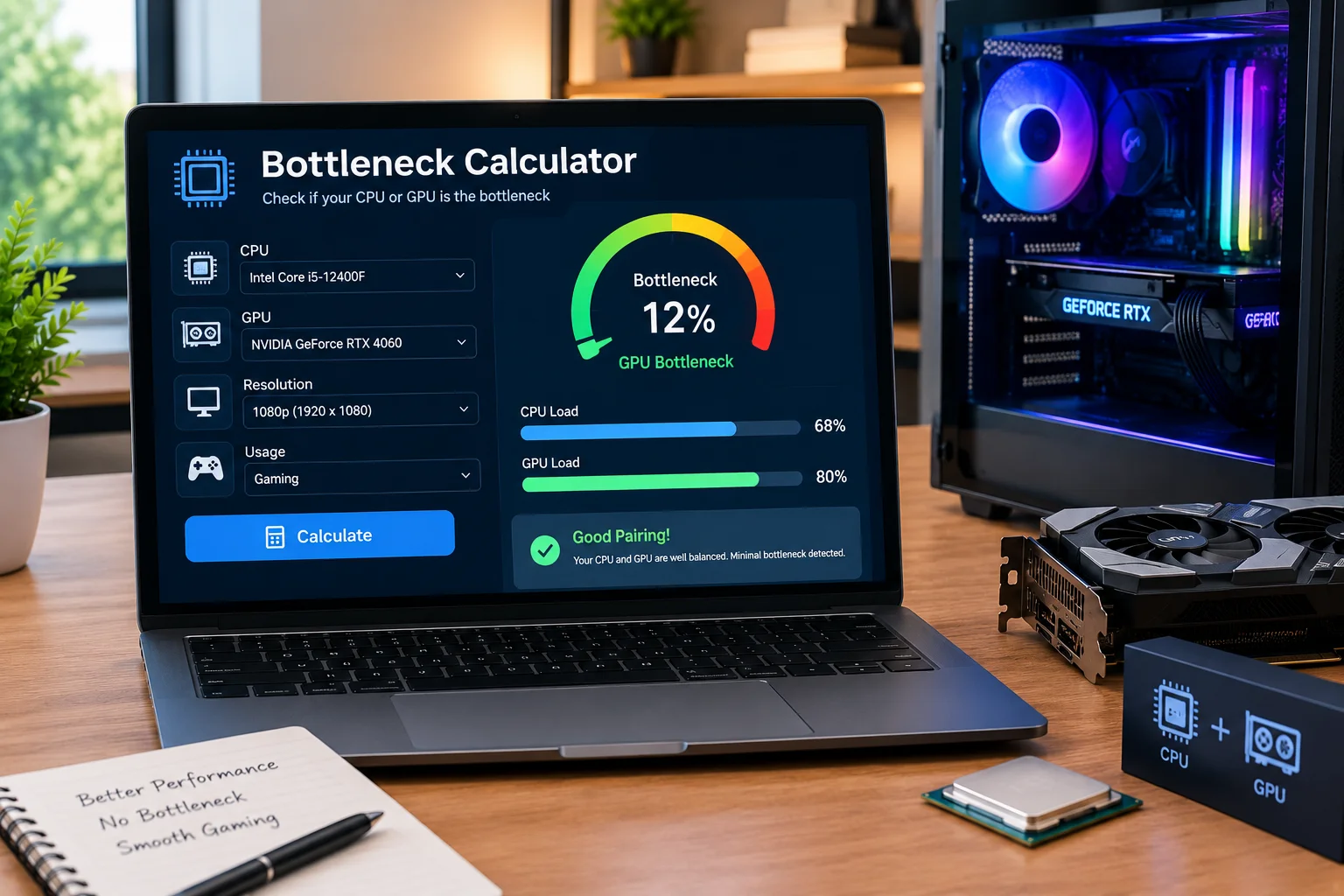
A good computer is not defined by a single powerful component. The processor, graphics card, memory, storage, cooling, and other hardware need to work together according to the tasks a user performs. When one component reaches its limits before the others, it can affect the overall experience. A bottleneck calculator PC can help users identify possible hardware limitations and make better decisions when building or upgrading a computer. With bottleneckcalculator, users can compare different hardware combinations and understand how their PC may perform in different situations.
What Is a PC Bottleneck?
A PC bottleneck occurs when one component becomes the main limitation during a particular workload. The component responsible for the limitation can change depending on the application, game, resolution, and performance target.
For example, a high-end graphics card paired with an older processor may experience CPU limitations in some games. A powerful CPU combined with a mid-range GPU may instead be limited by graphics performance. Neither situation automatically means the computer is poorly designed. What matters is whether the limitation affects the performance the user wants.
A bottleneck calculator PC provides an estimate that helps users understand this relationship before making hardware decisions.
Why Hardware Balance Is Important
Computer components should be selected as part of a complete system. Spending most of a budget on one component while choosing much weaker supporting hardware may not provide the best value.
A balanced configuration considers the intended games, applications, resolution, refresh rate, frame-rate goals, and future upgrade plans. This approach helps users spend money where it can make a meaningful difference.
Bottleneckcalculator can support this planning process by helping users compare CPU and GPU combinations before purchasing new hardware.
How a Bottleneck Calculator PC Works
A bottleneck calculator PC typically evaluates the relationship between a selected processor and graphics card. Some tools also consider resolution or workload to provide a more relevant estimate.
The result may indicate whether the CPU or GPU is likely to become the primary limitation in a specific scenario. However, calculator results should not be considered exact performance measurements.
Actual performance can change because of game engines, drivers, software optimization, RAM, cooling, background applications, graphics settings, and other system factors. A calculator is best used as an initial guide for hardware planning.
Understanding CPU Bottlenecks
The CPU performs many tasks that are essential for gaming and other demanding applications. It handles game logic, physics, artificial intelligence, calculations, application instructions, and background processes.
When a processor cannot keep up with a particular workload, it may limit the number of frames a graphics card can effectively produce. This can become more noticeable in CPU-intensive games or when targeting extremely high frame rates.
A bottleneck calculator PC can help users determine whether their selected processor is likely to work effectively with a particular graphics card.
Understanding GPU Bottlenecks
The GPU handles graphics rendering and visual processing. High resolutions, advanced lighting, detailed textures, ray tracing, and other demanding settings can place significant workloads on the graphics card.
A GPU bottleneck is often completely normal in demanding games. If the GPU is operating near full utilization while delivering the desired frame rate and image quality, it may simply be doing the work it was designed to perform.
Using bottleneckcalculator can help users understand whether their graphics card is likely to be the primary performance limit under their selected conditions.
Resolution Has a Major Impact
Resolution can change the balance between CPU and GPU workloads. At 1080p, the GPU generally processes fewer pixels than at 1440p or 4K. When users are aiming for very high frame rates at lower resolutions, CPU performance can become more important.
At higher resolutions, the GPU usually carries a heavier rendering workload. This often makes GPU limitations more visible.
For this reason, a bottleneck calculator PC should be evaluated using the resolution that matches your real gaming setup. Looking at a result without considering resolution can give an incomplete picture.
High Frame Rates and CPU Demand
High-refresh-rate gaming requires a computer capable of producing enough frames to take advantage of the display. A 60Hz monitor has a different performance target from a 144Hz, 165Hz, or 240Hz monitor.
When users target very high FPS, processor performance can become increasingly important in CPU-sensitive games. A powerful GPU may have the ability to render additional frames, but the CPU still needs to process the game logic and prepare the workload.
A bottleneck calculator PC can help users evaluate whether their chosen hardware makes sense for a high-FPS gaming setup.
Building a New Gaming PC
Before building a new PC, users should identify the tasks they care about most. A computer for competitive gaming may need a different balance from a system designed for 4K gaming, video editing, streaming, or 3D rendering.
Once the primary workload is known, users can compare potential CPU and GPU combinations. A bottleneck calculator PC can provide an estimate of how those components may interact.
This can help builders avoid choosing a very expensive GPU while pairing it with a processor that may limit its performance in their preferred games.
Checking Hardware Before an Upgrade
A calculator can also be useful for an existing PC. Before purchasing a new graphics card, users can evaluate whether their current CPU is suitable for the planned upgrade.
If the processor is already limiting performance, installing a significantly faster GPU may not produce the expected results in CPU-sensitive applications. In that situation, upgrading the CPU may be more useful.
Similarly, if the GPU is the main limitation, replacing the CPU alone may not provide a major improvement in graphics-heavy games.
RAM and Overall System Performance
RAM is another important factor in PC performance. Insufficient memory can lead to slowdowns, stuttering, and problems when running multiple demanding programs.
Although RAM is not usually the primary focus of a CPU-GPU bottleneck calculator, it should still be considered when diagnosing poor system performance. A computer with adequate CPU and GPU power can still feel slow if it does not have enough memory for the workload.
Users should therefore look at the complete system rather than focusing on one calculator result.
Storage and Loading Performance
Storage affects application loading, file transfers, operating-system responsiveness, and game loading times. Solid-state drives can provide significant improvements in these areas compared with older storage technologies.
However, storage performance does not normally remove a CPU or GPU bottleneck. If frame rates are limited by graphics processing, installing a faster drive will not suddenly increase GPU performance.
Understanding the role of each component helps users choose upgrades that address the actual problem.
Cooling and Thermal Management
Cooling can have an important effect on sustained CPU and GPU performance. During long gaming sessions or demanding workloads, inadequate cooling can cause temperatures to rise.
If components reach thermal limits, their performance may be reduced to manage heat. Users should check temperatures, airflow, fans, and cooling hardware when investigating unexpected slowdowns.
A bottleneck calculator PC helps estimate hardware balance, while monitoring temperatures can reveal whether thermal conditions are affecting the system.
Bottlenecks Depend on Different Workloads
There is no single bottleneck result that accurately describes every task performed by a computer. Different games and applications place different demands on hardware.
One game may rely heavily on CPU performance, while another may use the GPU much more extensively. Video editing, 3D rendering, streaming, and productivity applications can also have different requirements.
This means bottleneckcalculator should be used for the workload that matters to you. A result for one gaming scenario should not automatically be treated as a measurement of the entire computer.
Combine Calculator Results With Monitoring
A bottleneck calculator PC provides useful estimates, but real-world monitoring can add important information. Users can observe CPU utilization, GPU utilization, temperatures, frame rates, and frame-time behavior while running their preferred applications.
For example, high CPU usage combined with relatively low GPU utilization may indicate a CPU limitation in a particular game. High GPU utilization may suggest that the graphics card is doing most of the performance-critical work.
Using both estimated and real-world information gives users a more complete understanding of their system.
Do Not Focus Only on Bottleneck Percentages
Bottleneck percentages can be useful for comparison, but they should not be treated as universal rules. A specific percentage does not automatically mean that an upgrade is required.
The more important question is whether the limitation affects your actual experience. If a computer already provides the frame rate and quality you want, there may be little reason to replace hardware simply because a calculator reports a potential imbalance.
The purpose of a bottleneck calculator PC is to support better decisions, not encourage unnecessary upgrades.
Save Money Through Better Planning
One of the biggest advantages of analyzing hardware before purchasing it is the ability to avoid unnecessary spending. Instead of choosing components based only on price or popularity, users can consider how those components will work together.
Bottleneckcalculator can help users compare different configurations and identify options that are more appropriate for their workload and budget.
This is particularly useful for users building mid-range systems, where careful allocation of the budget can have a significant impact on overall performance.
Plan for Future Upgrades
A good PC build can also be planned with future upgrades in mind. Users may start with a balanced combination and replace one component later as performance requirements increase.
For example, a system might initially use a mid-range GPU and later receive a stronger graphics card. Checking the CPU and GPU relationship before the upgrade can help determine whether the existing processor remains suitable.
A bottleneck calculator PC can therefore be useful not only when building a computer but also when planning its future development.
Final Thoughts
PC performance depends on the interaction between multiple components. A bottleneck calculator PC provides a convenient way to estimate CPU and GPU balance and identify potential limitations before purchasing or upgrading hardware.
With bottleneckcalculator, users can compare configurations, consider resolution and frame-rate goals, evaluate upgrade options, and make more informed decisions. Calculator results are estimates rather than guaranteed benchmark figures, so they should be combined with real-world monitoring and testing when possible.
The best PC is not necessarily the one with the most expensive components. It is the one whose hardware is properly matched to the user’s workload, performance expectations, and budget.
